
Title: The Passenger
Author: Ulrich Alexander Boschwitz
Preface by: André Aciman
Original Language: German
Translated by: Philip Boehm
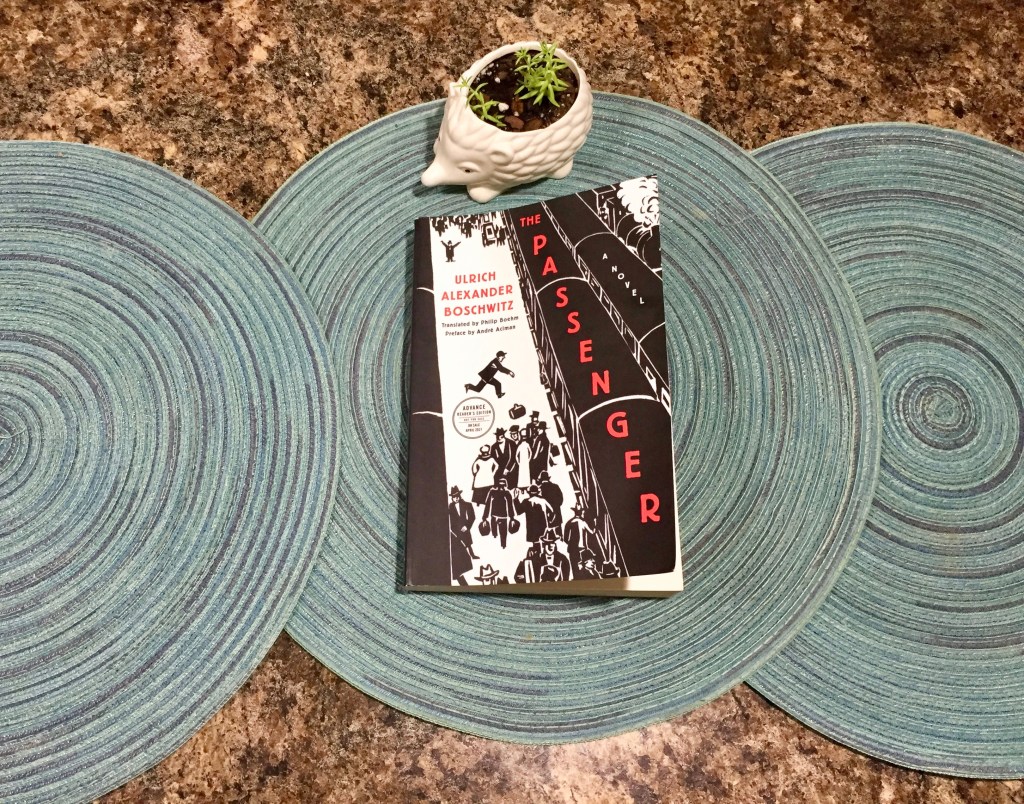
“It’s a well known fact that people who live in times of peace have no idea about war.”
Thank you Goodreads and Metropolitan Books for sending me this Advance Reader’s Edition of The Passenger by Ulrich Alexander Boschwitz. I am a historical fiction fan and when I won this book on Goodreads giveaway, my happiness went bouncing. What caught my attention immediately was that the original manuscript of this book had been long lost and recently been uncovered. This made me curious about the book and the author. I did some research in the matter and this is what I found:
About the Author:

Ulrich Alexander Boschwitz, the Guardian
Boschwitz (1915-1942) was a young man when he conceived this book. Born of an originally Jewish father (later converted to christianity) and a Protestant mother, Ulrich escaped to Sweden in 1935 following the promulgation of Nuremberg Laws. Later he moved to Paris, then Luxembourg and then Belgium. In 1939, shortly before the outbreak of World War Two, he joined his mother in England where he wrote the first draft of The Passenger. He was able to publish an early version of the novel in both England and France but it went pretty much unnoticed. Boschwitz was then sent to New South Wales, Australia aboard the HMT Dunera as an “enemy alien” along with other refugees from Germany and Austria where he spent two years in internment camp. Later in 1942, after the attack on Pearl Harbor in Hawaii, he was reclassified as “friendly alien” and was then freed. He boarded the troopship MV Abosso bound for England, which was torpedoed by German U-boats and unfortunately Ulrich Alexander Boschwitz perished along with 361 of his fellow passengers.
The Story of the Book:
“There was a risk that the story of this book might overwhelm the story in the book – its origin tale is quite something.” – theguardian.com
I agree. Both the novel and the story behind it are very intriguing.
The year was 1939 when Boschwitz first conceptualized this book. The events of Kristallnacht (Night of Broken Glass or the November Pogroms, when the Nazi Germans attacked Jewish persons and property) had affected him quite deeply. And so he wrote The Passenger in just four weeks. In his last letter to his mother in England, he wrote that he sent the first 109 pages of his reworked manuscript with a fellow prisoner on his way to England. Sadly there has been no knowledge of it being received.
It so happened that Boschwitz’s niece read an interview of editor Peter Graf about another novel that he had rediscovered. She contacted him and told him about Ulrich’s original German transcript and that it is sitting idle in the National Library of Frankfurt for over 70 years. The German publisher and editor Peter Graf connected with Boschwitz’s mother and eventually revised the rediscovered transcript. The novel reappeared in its revised form in its original language in 2018 with the title Der Reisende. It is now translated in 20 other languages including English. This translated copy by Philip Boehm is of the revised original version.
The Novel:
The year 1938, right before World War Two. It was like a heavy raincloud gradually moving over the Jews living in Germany. They knew it was a matter of time when the clouds will blast their fury. Most ran away to safer places, some left with everything, some with nothing, some didn’t at all thinking that things might just get better. Well, things didn’t get better. They just worsened and worsened for that community. Those who chose to stay were trapped, quite literally for Germany wasn’t letting them leave anymore and other countries didn’t want them in. Last they checked, Germany was still a democracy. It was unimaginable. And yet to everyone’s horror, it happened.
The story of Otto Silbermann came about after The Night of Broken Glass (November 9 – 10), when Nazis torched Synagogues, vandalized Jewish homes, terrorized and ransacked schools, property, businesses, cemeteries, hospitals everything. They killed over a 100 Jews, tortured them and arrested close to 30,000 Jewish men to be sent to concentration camps that one night. 60 million European Jews were systematically murdered during what was known as the Holocaust, Hitler’s “Final Solution” to the “Jewish Problem”.
Otto Silbermann, a very well doing, rich, Aryan-looking Jew had to flee from his home in Berlin leaving his belongings, business, and his Christian wife behind. A dutiful, tax paying, respected businessman and an upright citizen who was also at the front of The Great War had to flee like a petty criminal. What he did have was 40,000 Marks. His biggest mistake: he didn’t leave when he could and now he couldn’t even if he wished. Now all he could do was run.
“”Aren’t you at all afraid?” Lilienfeld defended himself. “I am. Of course. But I refuse to give in to my fear!” said Silbermann, nicely and firmly.”
What are the conditions that a person has to run even though he has everything in life? Yes, right….run for his life.
But what help would money do when you are on the run? He couldn’t go to a restaurant to eat for the fear of being spotted, he couldn’t rent a room, a hotel or anything. All he could do was sit in a train. Just leave…but to where? He travelled from one train to the other. From Berlin to Hamburg, back to Berlin, to Dortmund, to Aachen, back to Dortmund, to Küstrin, to Dresden and finally back to Berlin. All the while hiding his Jewish identity and clenching his briefcase full of money to his chest with all his might hoping that his Aryan nose will somehow save him.
“He stopped in front of a hotel and considered going inside. No, he thought, that won’t work! I can’t weaken, not when I’m this close to the goal, because not only am I trying to escape, I’m also running a race again despair.”
The beauty of this novel is that it is in its finest and purest form. Boschwitz gives us a taste of the Nazi Germany and the plight of Jews as it was happening around him. It is a peek into the sociology of the time just before the world war and the psychology of the predator and prey alike. Just like Silbermann, the protagonist of his novel, Boschwitz has had a desperate itinerary, moving from one place to the other and finally perishing on his journey to freedom. The terror in which the country was is utterly shameful. the social and economic status of Otto Silbermann could also not save him from his peril. That was the end of humanity as far as he was concerned. The novel beautifully portrays a man and a country totally on the loose, totally out of control, totally hapless. Absolutely prophetic, this book gives us but a glimpse into how humanity was being overturned. The loss is irreparable. The book is a masterpiece.

 The Spell Bound