
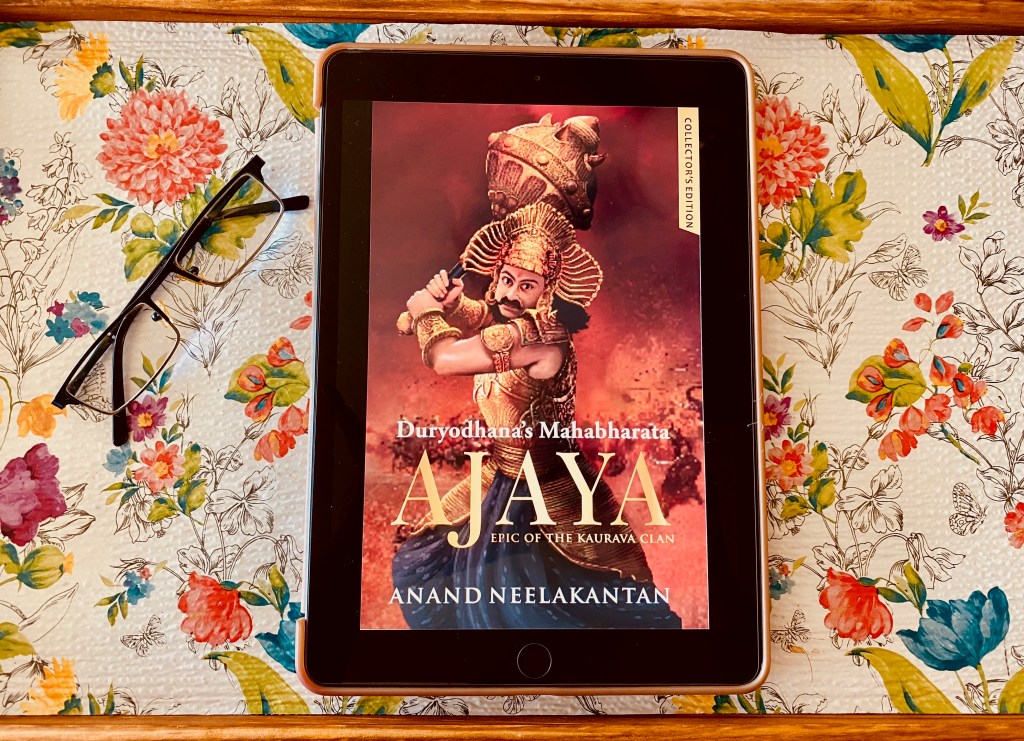
Title: Duryodhan’s Mahabharata AJAYA – Epic of the Kaurava Clan
Author: Anand Neelakantan
Genre: Historical Fiction, Mythical Fiction, Alternate History, High Fantasy
Book 1: Roll of Dice
Book 2: Rise of Kali
Original Language: English
With the aid of Universal Consciousness, the Virtues triumph over Desires.
AJAYA: Duryodhan’s Mahabharata, Epic of the Kaurava clan is a two book narrative (namely, ‘The Roll of Dice’ and ‘Rise of Kali’) of the Epic Mahabharata written by Anand Neelakantan who is famous for his book ‘Asura’.
There are always two sides of a coin, two versions of a story, two perceptions of a war. The war of Mahabharata was the war over dharma, the war over who is just and who is not, the war over what is right and what is wrong. We have always read (the books) or heard (the stories) or even watched (the tv series and movies) of the Mahabharata saga and they all point towards the winners of the war; the Pandavas as against the Kauravas. While Jaya is the story from the vantage point of the victorious Pandavas, Ajaya is the tale of the vanquished Kauravas who were said to be unconquerable and yet they were destroyed completely. It is a provocative perception to a conventional saga.
DHARMA
Is dharma a war fought without ethics and then glorified?
Because that is what happened in Mahabharata. The two parties became parties only after breaking up as a family. A war fought among family in itself is adharma in my opinion. A crime as heinous as this war had revered witnesses like the Grand Regent Pitamah Bhishma, Acharya Drona, Acharya Kripa, Vidur, Acharya Carvaka, the King Dhritarashtra, the Queen Gandhari, the dowager Kunti and above all Lord Krishna. How did they even land in a situation as that of the war, the biggest, gruesome and goriest of clashes at that?
What is dharma?
For Krishna, dharma is the call of duty.
For Drona, it was putra-moh, love for his son.
For Karna, it was his friend not his mother and brothers.
For Yudhishtir, it was to follow the path of his ancestors and to speak the truth.
For Kunti, it was maternal love.
For Suyodhana, it was his loyalty to friendship and Swadharm or following the heart.
For Balrama the pacifist, ahimsa or non violence was dharma and so he didn’t participate in the greatest war ever fought and took refuge in the jungles instead.
Even though Yudhishtir was officially dharma-putra, he had questions on what each persons dharma was. Bhishma’s explanation to him was that only Yama or time can decide what or what not is dharma.
According to Sage Narada, the three Vedas namely, Rig, Sam, Yajur are the cornerstones of dharma while Bhishma declares dharma as the root of Vedas. If that is to be held true then dharma is no constant. It is dynamic and keeps changing over time depending on the need of the hour. Krishna agrees to this yet he also says that the final authority lies with the scriptures. Krishna on the other hand advises that Nishkama karma or acts of devotion can be dharma.
No one can decide what is dharma and what is not dharma, who is the victor, and who is the vanquished. Mortals are but tiny specks in the vast universe, blips in the great ocean of time.
Does winning the Mahabharata war actually have deemed them to be ‘right’, since it was a war of dharma, even though they used unrighteous techniques and didn’t follow the rules of war? Does victory mean justice?
Why is Kurukshetra considered to be the dharamkshetra? Was it because it was a place where two definitions of dharma were in conflict and the certainty that winner takes it all?
Was burning Khandiva to the ground and so many of the residents killed or rendered homeless Pandava’s dharma?
Was looting cities and women after wars anyones dharma?
Was forceful marriage of Gandhari to a blind man after she was abducted and her family killed, her kingdom ruined dharma on Bhishma’s part?
The killing of sleeping children by Ashwathama (who by the way was a brahmin) in any decent way of the world dharma?
This debate is endless.
There are no victors or vanquished, just people and their lives.
In todays world, the line between dharma and adharma is very blurred, more often than not it is given the shape of blind devotion. Which was once speculative philosophy pivoted into absolute thoughts of good and evil.
Every argument has consequences, every fight has consequences, every war has consequences in multiple folds. No war has winners or losers, though there may be winning and losing parties. Everyone loses in a war in some way or the other. Its the men who lose their lives and their limbs, children who lose their fathers and brothers, wives who lose their husbands, families who lose everything in a war. So then who is the winner? Is it that one person who gets the high seat? Is it worth it? I wonder.
Ajaya: Duryodhan’s Mahabharata has opened my eyes and given me a new perspective to this age old epic which has never failed to glorify the Pandavas and defame the Kauravas. Suyodhan’s version of Mahabharata is very interesting and at the same time quite thought provoking.
Ananad Neelakantahan is a master at traditional mythology and the way he narrates the saga from an ‘anti-standpoint’ is thrilling. He throughout the narrative seamlessly enthralls and keeps the reader on edge by leaving little cliffhangers to mystify their imaginations. The writing is great. The style is very convincing. The character building is super strong. The narration powerfully gripping. The language is thoroughly understandable while keeping the vocabulary of common readers in mind.
The book very flatly speaking is pro Kauravas and anti Pandavas. The author has conveniently highlighted the Pandavas’ wrong doings and omitted some of Kauravas’. The text gets too pushy when it comes to glorifying Kauravas and too light when it is clearly evident that they may be at fault. All participants in the war had their own stories and personal grey areas but Neelekantan has taken the torch to highlight Suyodhan and how he may have been manipulated into the war given his stubborn and trusting nature.
Long story short, I feel the author has been biased in his writing but then wasn’t that the aim? To paint a picture from Suyodhan’s point of view? And might I say he nailed it!


Wow Surabhi ! Yes I get your point, but right or wrong , the battle was a must , to remove evil , even to this day we pray to God in helping us to do everything in the right way. So what’s wrong in Krishna helping the Pandavas with his methods.
Anyway , I still will read this book as it looks interesting. Have you seen the serial “ dharamkshetra ‘ on epic channel? See it please..
LikeLike
Thanks for your comment. I have watched ‘Dharamkshetra’ on netflix with my family and it surely piqued my interest. This review is my take on the book Ajaya, which is Duryodhan’s perspective of the war. In the book, Krishna is not portrayed as a God. He is just another character who has a great influence on the winning party. When they say ‘history is written by the winners’, I felt like this book is trying to show the other side of the story and thats what made me pick it. I do understand that this war was for dharma to prevail but I feel that war is an unnnecessary evil which is better avoided for the sustenance of the masses. There was cleansing for sure but at the cost of loss of life, limb and trust. I recommend you read the book. It will give you a new perspective.
LikeLike